How to Choose a Certified Mold Inspector in Sarasota, FL
Your Sarasota home is under constant moisture attack. The humidity here never stops. It sits at seventy percent year-round. Mold thrives in this environment. You’ll find it growing behind walls, in crawl spaces, under attics. The question isn’t whether mold exists in your home. The question is whether you’ll catch it before it becomes expensive.
Finding the right mold inspector matters more than most homeowners realize. The wrong choice costs you money. Worse, it misses serious health threats. A bad inspector might declare your home clean when hidden mold spreads through your walls. Another might see mold everywhere and push expensive remediation you don’t need. This guide shows you exactly what separates qualified inspectors from unqualified ones operating in Sarasota. You’ll learn which certifications actually mean something. You’ll discover red flags that protect you from predatory practices. By the time you finish reading, you’ll hire with confidence. If you’re ready to take the next step, our Sarasota mold removal specialists can help you find the right inspector and plan your inspection.
Why This Matters: Sarasota’s Mold Problem
Sarasota’s Perfect Storm for Mold
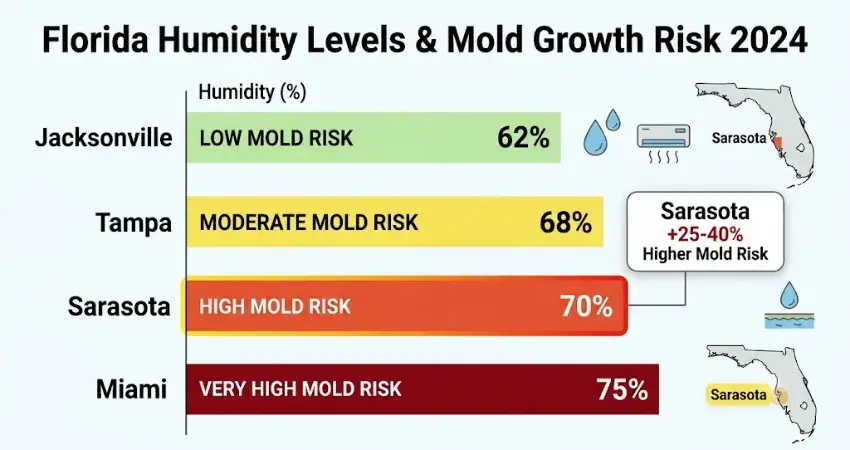
Sarasota’s climate creates ideal mold conditions. High humidity at seventy percent. Frequent rain. A water table just eight to twelve feet underground. These three factors combine to make Sarasota one of Florida’s highest-mold-risk areas.
Compare to Tampa at sixty-eight percent humidity and Jacksonville at sixty-two percent. That extra two to eight percent compounds daily. Your air conditioner runs constantly, producing condensation that feeds mold growth. Sarasota homes built before 1990 especially struggle because older construction predates modern humidity control systems.
Health Risks You Can’t Ignore
Mold exposure creates real health problems. The EPA recognizes this. Symptoms include sneezing, watery eyes, and nasal congestion. For people with asthma, mold exposure triggers attacks.
Some molds produce mycotoxins that cause serious illness with prolonged exposure. Children and elderly people suffer more severe reactions. An incomplete inspection misses these problems before health effects appear. A thorough inspector finds hidden mold early and prevents expensive health consequences. The EPA provides detailed guidelines on mold health effects and proper moisture control in homes.
Cost of Hiring the Wrong Inspector
Cheap inspections cost more money over time. A basic visual-only inspection costs three hundred dollars. It misses seventy to eighty-five percent of actual mold. You discover the problem weeks later. Now it’s spread. Remediation costs jump from two thousand dollars to six thousand dollars. You’ve paid for an inspection that wasted your money.
Poor inspectors make opposite mistakes too. Some see mold where none exists. They recommend expensive remediation. Insurance denies claims for false positives. You pay out of pocket for unnecessary work. A Lakewood Ranch homeowner hired an uncertified inspector last year. The inspector claimed extensive mold contamination. The homeowner agreed to ten thousand dollars in remediation. A second certified inspector found no actual mold. The first inspector was wrong. That homeowner wasted ten thousand dollars.
The cost isn’t just money. It’s peace of mind. A thorough certified inspector gives you confidence. You know the inspection was done right. You know any mold was found. You can trust the recommendations.
Understanding Mold Inspector Certifications
IICRC Certification
IICRC stands for Institute of Inspection, Cleaning and Restoration Certification. This organization sets industry standards. IICRC Mold Inspection and Assessment certification requires thirty hours of formal training. Training covers mold biology, sampling methods, health effects, and moisture dynamics.
The training includes hands-on practice with equipment. Inspectors learn to use moisture meters and spore traps. They understand thermal imaging cameras. They learn to interpret air samples. This is practical expertise, not just theory. Annual renewal and continuing education keep knowledge current. For detailed IICRC training requirements, visit IICRC’s official certification page
ACAC Certification & CMI Designation
ACAC is the American Council for Accredited Certification. Their Certified Microbial Investigator (CMI) credential requires documented prior inspection experience. Training covers mold biology, mycology principles, health risk assessment, and indoor air quality testing.
ACAC maintains strict ethical standards and a code of conduct. Certified inspectors prioritize client safety and avoid conflicts of interest. ACAC-certified inspectors often specialize in complicated cases requiring advanced expertise. When these inspectors identify mold, they know exactly what they’re looking at. Understanding the difference between black mold and other mold types helps you understand why their findings matter. Some molds pose greater health risks than others.
Florida State Licensing
Florida requires environmental testing licenses for professionals conducting mold testing for hire. State licensing ensures minimum competency and provides consumer protection. You can verify licenses through the Florida Department of Business and Professional Regulation website.
State licenses differ from certifications. A license proves minimum legal requirements. Certifications like IICRC and ACAC go beyond minimum requirements. An inspector holding both a state license and IICRC certification has met legal requirements and industry best practices.
RED FLAGS: Inspectors to Avoid
Inspector + Remediation Company Conflict
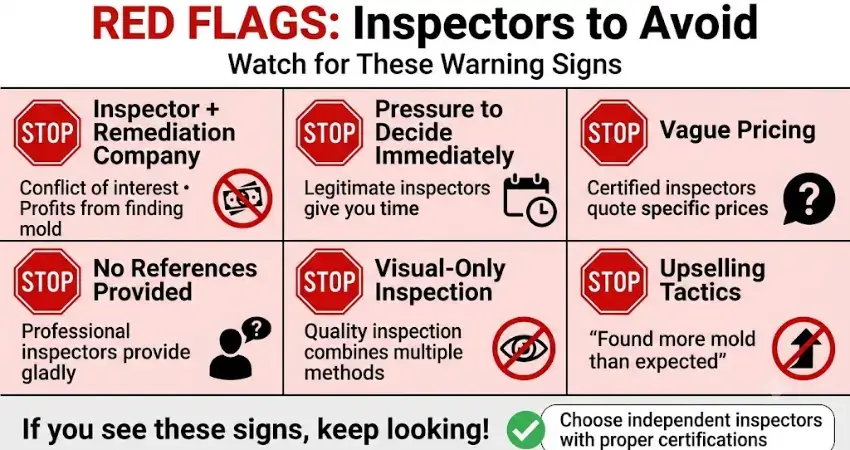
Many mold companies do both inspection and remediation. This creates massive conflict of interest. The inspector’s company profits when mold is found. They profit when expensive remediation is recommended.
Ask directly: “Does your company perform remediation work?” If yes, walk away. Independent inspectors have no conflict. They make money from inspection fees only. They have no incentive to find problems.
Other Warning Signs
Pressure to decide immediately signals problems. Legitimate inspectors give you time and provide written quotes. Vague pricing is a red flag. Certified inspectors quote specific prices, explaining what’s included.
Refusal to provide references is suspicious. Professional inspectors provide previous clients gladly. Offering only visual inspection without lab testing limits effectiveness. Quality inspection combines multiple methods.
Upselling Tactics
“We found more mold than expected” should trigger skepticism. Mold doesn’t suddenly appear. “Immediate remediation required” creates urgent pressure when mold grows slowly. “We have a special discount today only” indicates sales pressure.
Professional inspectors maintain consistent pricing. They don’t offer time-limited discounts. Watch for patterns of constant add-ons suggesting upselling rather than legitimate needs. Legitimate findings matter; if an inspector finds black mold in your home, that’s a genuine concern worth professional remediation, not an upselling tactic.
Certification Comparison: Side-by-Side Guide
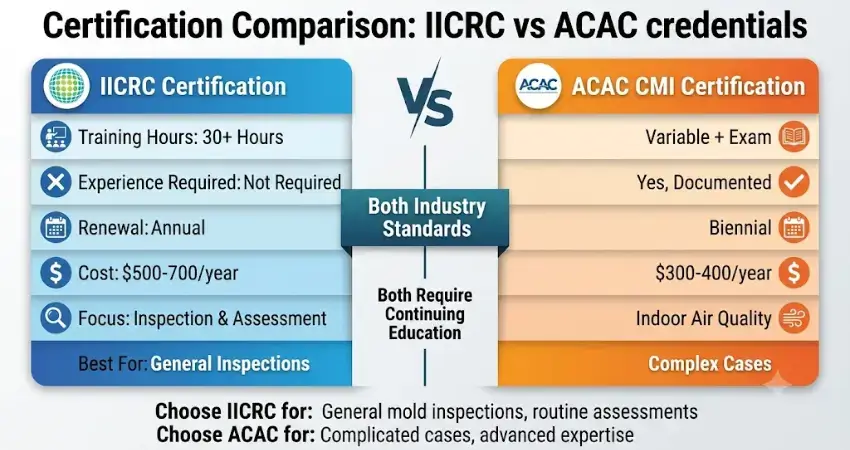
IICRC Certification Details
The IICRC Mold Inspection and Assessment certification requires thirty hours minimum of formal training. Training covers mold biology, sampling methods, health effects, and Sarasota-specific conditions. The training includes hands-on equipment practice.
Renewal happens annually. Inspectors complete continuing education credits yearly. Cost for initial certification runs three hundred to four hundred dollars. Renewal costs less, typically two hundred to three hundred dollars. Annual continuing education adds another one hundred to two hundred dollars. This ongoing cost ensures inspectors stay current.
ACAC Certification Details
ACAC’s Certified Microbial Investigator requires documented experience first. You can’t just take a class. You must show prior inspection work. You must document cases completed. Then you complete training and pass examination.
Renewal happens every two years. ACAC requires continuing education. The biennial cycle means lower annual cost than IICRC but higher per-renewal cost. Initial certification investment is higher due to experience requirements. But biennial renewal is less frequent.
Quick Comparison Table
|
Factor |
IICRC |
ACAC |
|---|---|---|
|
Training Hours |
30+ hours |
Variable + exam |
|
Experience Required |
Not required |
Yes, documented |
|
Renewal Cycle |
Annual |
Biennial |
|
Annual Cost |
$500-700 |
$300-400 |
|
Focus Area |
Inspection & Assessment |
Indoor air quality |
|
Depth |
Broad |
Specialized |
|
Hands-on Training |
Extensive |
Moderate |
|
Best For |
General inspections |
Complex |
The Inspection Process Explained (Step-by-Step)
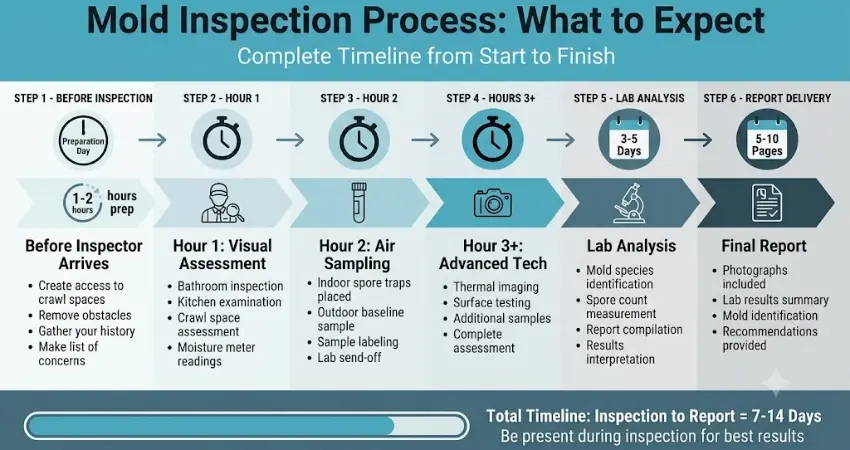
Before the Inspection Arrives
Prepare your home for inspection. Create access to crawl spaces and attics. Remove obstacles from the inspector’s path. Don’t clean excessively. Let the inspector see the home as it actually exists. Extreme cleaning can hide evidence of moisture problems.
Gather your history. Document any water damage from past storms. Note any roof leaks you’ve experienced. Tell the inspector about areas smelling musty. This history helps the inspector focus on likely problem areas. It provides context for findings.
Make a list of concerns. Have you noticed mold anywhere? Do certain rooms smell musty? Does anyone in your family have increased allergies? Share these concerns when the inspector arrives.
Hour 1: Visual Assessment & Moisture Detection
The inspector begins with a thorough walkthrough. They examine bathrooms first—moisture hotspots. They check kitchens for dishwasher leaks and moisture. They look for water stains and wall base damage.
Crawl space inspection is critical in Sarasota. The high water table means crawl space moisture is common. Inspectors photograph conditions, check for visible mold, assess vapor barriers, and look for standing water.
Hour 2: Air Quality Sampling
Air sampling provides objective data. The inspector places spore traps indoors and outdoors. Spore traps capture mold spores floating in air. Outdoor samples provide baseline context. Lab analysis typically takes three to five days.
Why baseline matters? Outdoor air contains mold spores naturally. Indoor air should have similar or lower levels. If indoor levels exceed outdoor significantly, that indicates indoor mold growth.
Hour 3+: Advanced Technology
Thermal imaging cameras reveal temperature differences. Cooler areas indicate moisture. Moisture evaporates, cooling the material. Thermal cameras show these cool spots. This technology identifies potential hidden mold locations before visible signs appear. In Sarasota’s humid environment, thermal imaging catches problems early.
Surface testing involves tape lifts or swabs. The inspector collects samples from suspected areas. These samples go to the lab. Lab analysis identifies mold type. It quantifies mold levels. Results compare to normal background levels. Some surface mold is normal. Excessive contamination indicates a problem.
The inspector might recommend different testing based on initial findings. Extensive crawl space moisture might warrant additional air samples. Visible water stains might require surface testing. The comprehensive approach gathers multiple data points.
Complete Timeline
Lab analysis takes three to five days. The inspector compiles a comprehensive report with photographs, visual assessment notes, lab results, mold identification, severity assessment, moisture sources, and recommendations.
A complete report requires five to ten pages minimum. Short reports lack necessary detail. Written reports provide documentation for insurance claims and prove professional assessment. Ready to schedule your professional mold inspection in Sarasota? Our certified inspectors provide exactly this level of comprehensive reporting.
Timeline: Lab Results to Report Delivery
Lab analysis takes three to five days typically. Some samples take seven days. During analysis, technicians culture samples. They identify mold species. They count spore levels. They generate detailed reports. These reports include photographs, test results, and interpretation.
The inspector reviews lab results once received. They compile a comprehensive report. This report includes:
- Photographs of affected areas
- Visual assessment notes
- Lab results and interpretation
- Mold type identification
- Severity assessment
- Moisture sources identified
- Recommendations for remediation
- Timeline for action
A complete report requires five to ten pages minimum. Short reports lack necessary detail. Written reports provide documentation. They become important if insurance claims arise. They provide proof of professional assessment.
Sarasota Neighborhoods & Different Inspection Needs
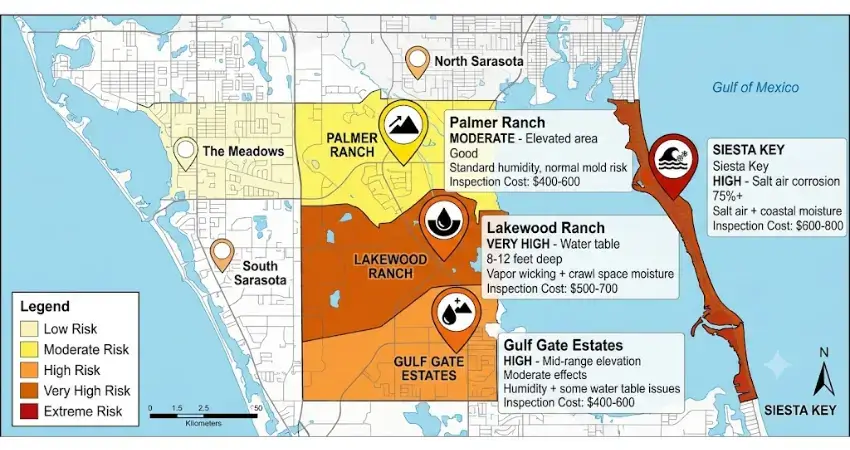
Siesta Key & Beachfront Properties
Siesta Key’s beachfront location comes with inspection challenges. Salt air corrodes equipment constantly. Your outdoor AC unit rusts faster here. Drain pans develop pinholes. Refrigerant lines corrode.
Humidity on Siesta Key exceeds seventy-five percent regularly. Ocean air brings extra moisture. Mold appears faster here than inland. Inspectors familiar with Siesta Key know to check coastal-specific areas. Expected inspection cost runs six hundred to eight hundred dollars.
Lakewood Ranch & High Water Table Areas
Lakewood Ranch sits lower than coastal areas. The high water table creates different problems. Water wicks upward through foundations. Crawl spaces stay perpetually damp. This moisture feeds mold growth continuously.
Vapor wicking is a specific problem here. Even with proper drainage, ground moisture climbs foundation walls. Inspectors experienced with high water table areas understand this. They test crawl space conditions thoroughly and check vapor barrier effectiveness. Expected inspection cost runs five hundred to seven hundred dollars.
Palmer Ranch & Elevated Neighborhoods
Palmer Ranch elevation provides drainage advantages. Water doesn’t accumulate like lower areas. Mold growth is slower here. Inspection needs are less intensive than water table areas.
Palmer Ranch still experiences seventy percent humidity. Standard comprehensive inspection usually suffices. Focus on roof condition, ventilation, AC condensation, and any previous water damage. Expected cost runs four hundred to six hundred dollars.
Gulf Gate & Other Neighborhoods
Gulf Gate sits in mid-range elevation. Water table effects are moderate. Humidity is standard seventy percent. Mold risk is average for Sarasota.
When choosing an inspector, ask about neighborhood experience. “How many inspections have you done here?” Neighborhood knowledge adds significant value to your inspection.
Cost Breakdown: What You’ll Actually Pay
Visual-Only Inspection ($200-$300)
A visual-only inspection costs the least. The inspector walks through your home looking for visible mold. They use a moisture meter. No lab testing occurs. No samples are collected.
This approach has limitations. It only finds visible mold. Hidden mold behind walls stays hidden. It’s adequate only for homes showing no obvious problems.
Air Quality Testing Inspection ($400-$600)
This is the most common inspection level. It includes visual assessment plus air sampling. The inspector examines thoroughly and places spore traps. Lab testing confirms whether mold contamination exists.
Lab results prove whether mold exists objectively. Spore counts compare to outdoor baseline. Most Sarasota homeowners choose this option. It balances cost and comprehensiveness effectively.
Advanced & Complete Inspections ($500-$900)
Thermal imaging inspection costs $500-$750 and reveals moisture before visible mold appears. Cool spots indicate evaporating moisture. Early detection prevents bigger problems.
Complete package at $600-$900 includes everything combined. Leave nothing to chance. Every assessment method applies. Extensive documentation and detailed recommendations included.
Why Sarasota Costs More
Sarasota inspection costs run fifteen to twenty-five percent higher than national average. Climate complexity requires specialized knowledge. Extended crawl space work takes more time. Inspector expertise commands higher rates.
The premium is worth it. Cheap inspection in Sarasota misses problems. Problems missed become expensive remediation. Paying more for quality inspection saves money overall.
How to Verify Inspector Credentials (Detailed Guide)
Step 1: Ask for Certification Proof
When an inspector quotes your inspection, ask directly: “What certifications do you hold?” Write down exactly what they claim. Ask for documentation. Professional inspectors have this readily available.
Red flags include vague responses, no documentation offered, credentials that have lapsed, or claims of self-certification.
Step 2: Verify IICRC Certification
Go directly to IICRC.org. Don’t rely on their word. The IICRC website has a certification holder directory. Search by last name or credential number.
The system shows inspector name, credential held, issue date, and expiration date. Verify the credential matches what they claimed. Verify it hasn’t expired. An expired credential means they stopped maintaining certification.
Step 3: Verify ACAC Certification
Go to ACAC.org. Search for CMI designation holders. Verify the specific credential matches. Check expiration date. Confirm biennial renewal is current.
An expired credential means stopped continuing education. This suggests they’re not staying current with standards.
Step 4: Check Florida State Licensing
Visit the Florida Department of Business and Professional Regulation website. Search their database for environmental testing licenses. Not all mold inspectors need state licenses. But if they claim one, verify it.
The database shows license type, number, issue and expiration dates, and any disciplinary actions. Disciplinary actions are red flags indicating pattern problems.
Step 5: Verify Insurance & Bonding
Professional inspectors carry liability insurance. This protects you if they cause damage. It proves they’re established professionals. Ask for proof of insurance.
Legitimate policies include the insurance company name, policy number, coverage amounts, and policy dates. Coverage of one million dollars or more indicates a serious operation.
Experience & Reputation Verification
Checking Online Reviews
Google reviews provide real homeowner feedback. Check their inspection business page. Look for patterns in reviews. Multiple five-star reviews indicate consistent quality.
Read detailed reviews carefully. “Found hidden mold in crawl space” is specific. “Very thorough” is vague. Detailed positive reviews carry more weight. Check BBB ratings and Yelp reviews for additional perspective.
Red flags in reviews include pressure to remediate immediately, overcharging for services, recommending unnecessary work, and poor communication.
Requesting & Calling References
Ask for three to five recent references. Professional inspectors provide them gladly. They’ve done quality work. Previous clients will confirm this satisfaction.
When calling references, ask: “How thorough was the inspection?” “Did they pressure you toward remediation?” “Would you hire them again?” “What was their communication style?” “Were costs what they quoted?”
Good references describe specific things the inspector found. They mention particular problem areas assessed. They remember the process clearly.
Sarasota-Specific Experience
Ask how many inspections they’ve done in your neighborhood. An inspector with twenty Siesta Key inspections knows coastal challenges better than someone with two.
Ask about post-hurricane inspections they’ve completed. This matters during hurricane season. Inspectors experienced with water damage understand water damage patterns. They know what to look for after storms.
“Tell me about a challenging Sarasota case you’ve handled.” Good inspectors have interesting stories. They describe complex situations and explain how they solved problems. These stories demonstrate actual Sarasota expertise.
Essential Questions to Ask Before Hiring
Your Next Steps
Call three to five candidates. Ask about certifications and experience. Get written quotes. Professional inspectors answer thoroughly without pressure.
Verify credentials online using IICRC.org, ACAC.org, and Florida DBPR. Request proof of insurance. Ask the essential questions from this guide.
Schedule your inspection and get written confirmation. Be present during the inspection. Review the report carefully and contact the inspector with questions. Take your time deciding next steps based on professional recommendations.
Conclusion: Don’t Rush This Decision
Choosing a mold inspector affects your health and finances. This decision deserves careful consideration. Don’t hire the cheapest option. Don’t hire based on one phone call.
Verify credentials. Check reputation. Ask questions. Take your time. A certified, experienced, Sarasota-knowledgeable inspector delivers value. They find problems early. They provide objective assessments. They protect your investment and family’s health.
Sarasota’s unique climate demands specialized expertise. Local inspectors understand this. Invest in quality inspection. It costs a few hundred dollars. It prevents thousands in future remediation. It provides peace of mind.