Why Sarasota’s Humidity Creates Perfect Mold Conditions
Mold is everywhere in Sarasota. Your neighbor battles it. Your friends deal with it. Your home probably has it. This isn’t a coincidence. Sarasota’s climate doesn’t just allow mold. It demands mold existence.
Understanding why mold thrives here changes how you approach prevention. You stop blaming yourself for “letting” mold develop. You recognize that our environment works against you. Acceptance doesn’t mean defeat—it means strategic defense.
The answer lies in humidity. Sarasota’s air carries moisture constantly. This moisture enables mold to thrive where it would die elsewhere. Geography, climate, and our coastal location create conditions mold loves.
This guide explains what makes Sarasota different. You’ll understand why homeowners in Colorado or Arizona rarely face mold. You’ll see why Sarasota homeowners must remain perpetually vigilant. Understanding the “why” guides smarter prevention choices.
Understanding How Humidity Enables Mold Growth
Mold needs moisture to survive. Not just any moisture; specific moisture levels trigger spore germination and colony establishment.
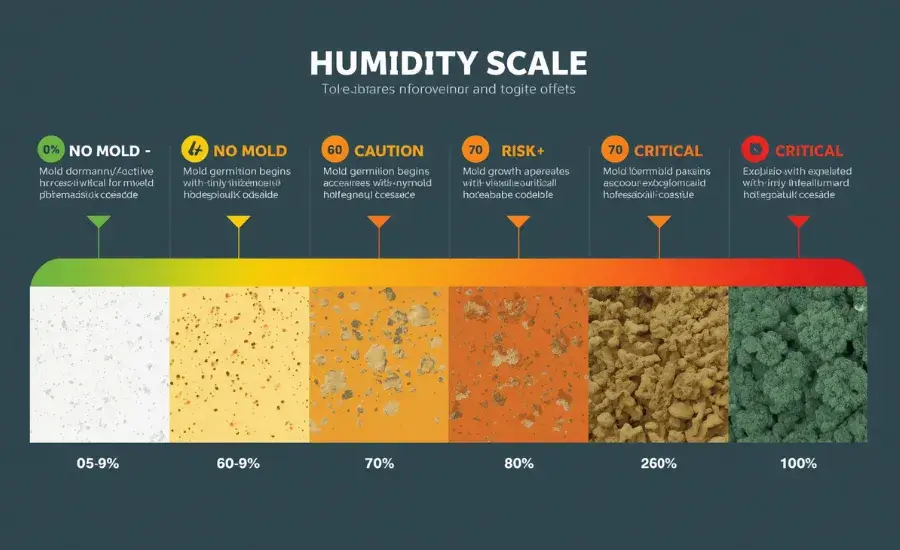
Mold spores exist everywhere. Air carries them constantly. Your home hosts millions of dormant spores right now. These spores remain inactive until conditions align. Humidity above 60 percent triggers germination. Humidity above 70 percent accelerates growth dramatically. Humidity above 80 percent creates explosive mold establishment.
This threshold matters scientifically. Below 60 percent humidity, mold cannot establish. Spores remain dormant. Growth stops. Existing colonies shrink. This is why desert climates rarely battle mold—humidity stays below critical thresholds naturally.
Above 60 percent humidity, mold awakens. Spores germinate within 24 hours of sustained moisture. Growth begins slowly initially. Within 48 hours, visible colonies form. Within a week, substantial coverage appears. Within months, extensive infestation develops.
The humidity threshold determines everything. A home at 59 percent humidity remains mold-resistant. A home at 61 percent humidity becomes mold-vulnerable. That two-percent difference determines whether your family battles mold or remains spore-free.
Temperature matters too, but less than humidity. Mold grows in cold basements and hot attics equally well. Temperature affects growth speed somewhat. Humidity determines whether growth happens at all.
Moisture retention matters equally. Materials must stay wet long enough for mold to establish. Fast-drying surfaces resist mold better than materials that absorb water deeply. Drywall absorbs water and dries slowly. Concrete absorbs less but dries even slower. Wood absorbs water and retains it indefinitely. These material properties interact with humidity. High humidity slows material drying dramatically.
This is mold’s foundation requirement: sustained moisture. Sarasota provides this constantly.
Sarasota’s Baseline Humidity Vs. Other U.S. Climates
Sarasota’s baseline humidity is fundamentally different from most U.S. locations.
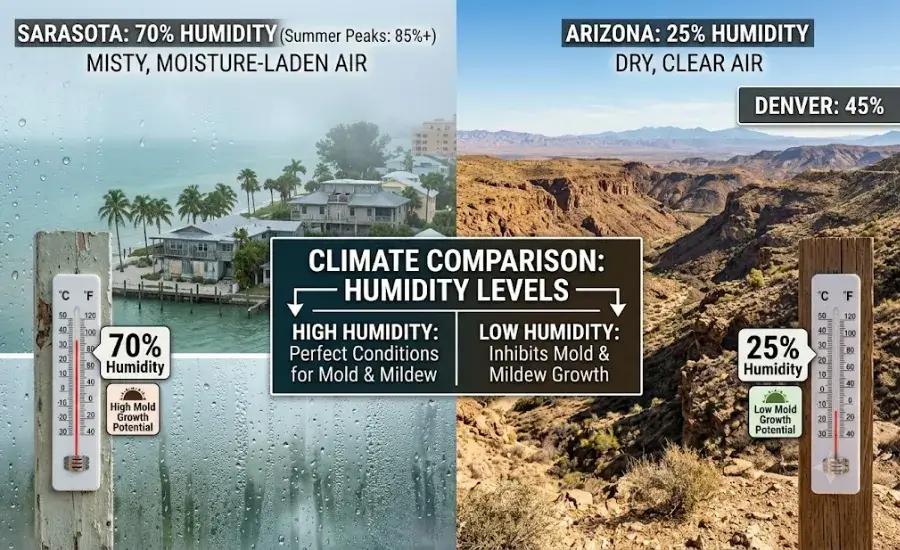
Average humidity in Sarasota sits at 70 percent year-round. This statistic deserves attention. Seventy percent means our “normal” air already approaches the mold-triggering threshold. We start with a disadvantage before considering seasonal variations.
Compare this to other regions: Denver averages 45 percent humidity. Phoenix averages 25 percent humidity. Miami averages 75 percent humidity. New York averages 55 percent humidity. Seattle averages 65 percent humidity.
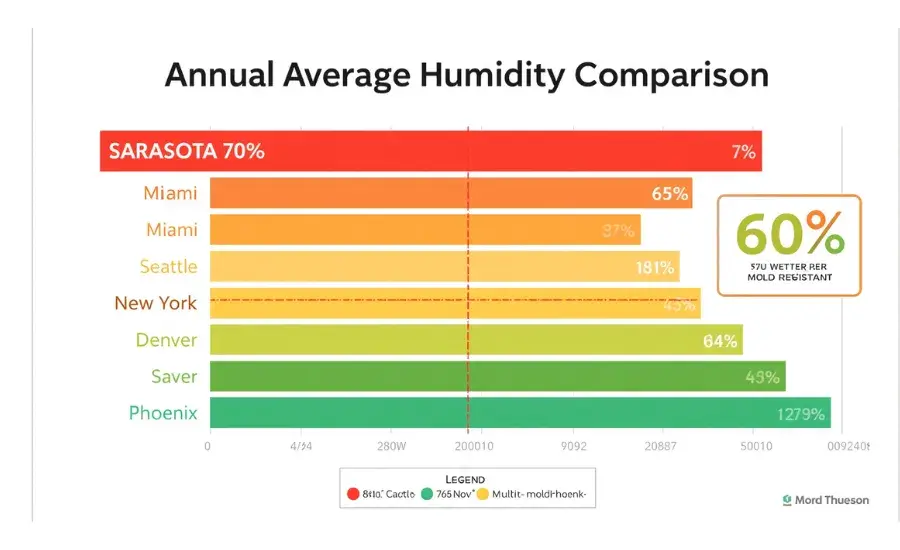
Sarasota’s 70 percent baseline exceeds nearly every major U.S. city. We’re wetter than Denver by 55 percent. We’re wetter than Phoenix by 180 percent. We rival Miami—our immediate coastal neighbor. This isn’t dry climate. This is subtropical moisture dominance.
What does 70 percent humidity feel like? It’s not obviously wet. You don’t see visible water droplets. Your hair might frizz slightly. Your clothes feel slightly damp. But 70 percent humidity feels almost normal because you’re accustomed to it.
This psychological reality masks the mold danger. Sixty-eight percent humidity feels fine. Seventy-two percent humidity feels fine. But those four percent swings bridge the mold threshold. Your home could harbor rapid mold growth while feeling merely humid.
Indoor humidity runs higher than outdoor humidity. Your home traps moisture. Air conditioning cool down interior temperatures. This temperature differential causes condensation. Showers, cooking, and daily activities introduce moisture. Building materials absorb and retain this moisture. Indoor humidity easily reaches 70-75 percent even when outdoor humidity is merely 70 percent.
This creates a compounding problem. You start at 70 percent outdoor humidity. Indoor activities push humidity to 75-80 percent. Mold activation threshold is 60 percent. Your home isn’t just meeting the threshold—it’s exceeding it significantly.
Geography determines this baseline. Our Gulf Coast location means Atlantic water vapor influences air constantly. The ocean water temperature warms air year-round. Warm air holds moisture readily. Sarasota’s latitude means we receive tropical weather patterns May through November. During these months, humidity regularly exceeds 85 percent.
Summer Humidity Peaks: June Through September
Summer months create extreme humidity conditions in Sarasota.
June through September, outdoor humidity regularly exceeds 85 percent. Some days peak at 90 percent humidity. Afternoon thunderstorms bring humid air inland. Evening temperatures cool but humidity remains elevated. Morning air arrives saturated from overnight condensation.
Four-month humidity peaks differ dramatically from other regions. Colorado sees dry, hot summer months. Arizona welcomes low-humidity heat. The Northeast experiences dry spells. Sarasota experiences relentless moisture dominance.
Indoor humidity during summer reaches critical levels. Without aggressive dehumidification and ventilation, indoor humidity easily climbs above 80 percent. This isn’t a high-humidity alert level; it’s mold explosion territory.
Why does summer humidity peak so severely? Tropical weather systems dominate the Gulf. Ocean water temperature peaks in summer. Warm ocean water evaporates moisture aggressively. Atlantic trade winds carry this moisture inland. Morning heating intensifies evaporation further. The moisture accumulates in our atmosphere.
This summer humidity pattern explains seasonal mold intensification. Spring mold growth accelerates in May. Summer months see rapid expansion. Growth peaks in September. Fall brings slight relief. Winter months show slower growth but don’t eliminate it.
Neighborhoods facing the Gulf experience more intense summer humidity. Siesta Key properties sit directly on the coast. Humidity there peaks higher than inland areas. Lido Key residents face similar challenges. These coastal neighborhoods show more aggressive mold than inland Palmer Ranch or Lakewood Ranch.
The water itself matters. Gulf water temperature reaches 88 degrees by August. Warm water evaporates continuously. This creates a moisture engine. Sarasota residents live downwind of an evaporation factory.
Summer air conditioning becomes essential, not optional. Running AC continuously doesn’t eliminate mold risk—it creates a secondary problem. Cooling creates condensation. This paradox requires aggressive dehumidification alongside air conditioning.
Coastal Salt Air Complicates Sarasota Moisture Problems
Sarasota’s coastal location introduces another humidity complication: salt air.
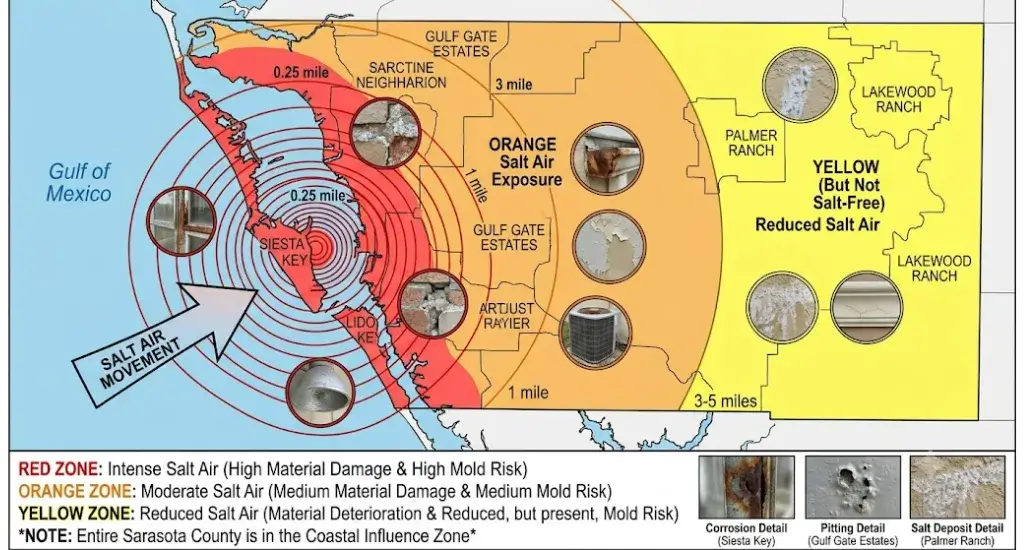
Ocean salt deposits settle on all surfaces. This salt absorbs moisture aggressively. Salt attracts water vapor from humid air. Salt deposits hold onto water tenaciously. Materials coated with salt remain damp longer than materials without salt exposure.
This affects homes differently based on distance from water. Siesta Key and Lido Key properties sit within a quarter-mile of the Gulf. Salt air concentration there is intense. These properties require more aggressive moisture management. Mold establishes faster. Growth accelerates quicker.
Properties three to five miles from water, like parts of Palmer Ranch and Lakewood Ranch, experience reduced salt air. But they’re not salt-free. Sarasota County sits entirely within the coastal influence zone. Even inland properties receive salt-laden breezes.
Salt air doesn’t create new problems—it accelerates existing ones. High humidity enables mold. Salt air extends that humidity by trapping moisture longer. The combination proves formidable.
This is why Gulf Gate Estates, sitting midway between coast and inland areas, shows moderate mold problems. Neither purely coastal nor fully inland, these neighborhoods experience salt influence without maximum intensity.
Window frames, door frames, and exterior walls deteriorate faster with salt air. The salt promotes corrosion. Corroded metal doesn’t seal properly. Air leaks increase. Moisture penetrates more readily. Interior materials absorb more water.
Paint deteriorates faster with salt air. Protective coatings break down. Underlying materials expose directly to moisture. Once protected materials become vulnerable. Mold colonizes faster on damaged surfaces.
Gutters corrode faster with salt air. Gutter integrity fails sooner. Water diversion toward foundations improves. Moisture penetration into crawl spaces accelerates. Basement seepage worsens. Crawl space mold establishes more readily.
Understanding salt air helps explain why homeowners can’t simply copy mold prevention strategies from inland regions. The additional salt factor requires supplementary efforts.
Air Conditioning Ironically Creates Mold Conditions
Sarasota homeowners rely on air conditioning. Our climate demands constant cooling. But AC systems create a mold paradox: they cool while creating moisture.
Air conditioning works through evaporative cooling. Cool refrigerant passes through indoor coils. Warm air from your home passes over these cold coils. Moisture in air condenses on coils. This condensation must drain outside your home.
Properly functioning AC systems drain this condensation continuously. Water exits your home. Humidity drops. Mold risk decreases. The system works correctly.
But AC systems often malfunction. Condensation drain lines clog. Water backs up inside the system. Standing water accumulates in condensation pans. Mold and bacteria colonize this wet environment. When the AC runs, it spreads mold spores throughout your home.
This paradox frustrates homeowners. You run AC to cool. AC production creates moisture problems. Your effort to solve one problem creates another.
Condensation drain lines need quarterly cleaning. Most homeowners ignore this maintenance. Dust, algae, and mineral deposits accumulate. Drain lines become partially or completely blocked. Moisture backs up. Your AC system becomes a mold incubator.
Temperature differentials compound this problem. Indoor AC temperature drops to 72 degrees. Outdoor temperature reaches 92 degrees. This 20-degree temperature differential causes aggressive condensation. Moisture condenses on exposed surfaces—outside walls, windows, pipes, and air conditioning units.
Nighttime temperatures cool slightly but remain humid. Morning heating reactivates condensation. Humidity spikes before AC cycles restart. This daily rhythm creates constant moisture cycling.
Energy-efficient homes seal tightly to prevent cool air escape. This tight sealing traps humidity inside. Without adequate ventilation, humidity accumulates. The cooling system removes some moisture but can’t eliminate all of it. Humidity remains elevated despite constant air conditioning.
This is why Sarasota homeowners who run AC constantly still experience mold. The system addresses temperature but inadequately addresses humidity. Supplementary dehumidification becomes necessary for homes with persistent moisture problems.
High Water Table Contributes to Sarasota Mold Risk
Sarasota’s geography includes a factor most U.S. homeowners never encounter: an extraordinarily high water table.
Sarasota sits on Florida’s Gulf Coast. The ground water table sits extremely shallow. In many areas, groundwater sits within 10 feet of the surface. In some locations, it’s even shallower.
This shallow water table means constant groundwater pressure against foundations. Water naturally seeks lowest points. Your home sits atop this water source. Hydrostatic pressure pushes water toward your foundation constantly.
Basements and crawl spaces become moisture collection zones. Water seeps through foundation cracks slowly. Standing water collects in sump pits. Moisture evaporates into crawl space and basement air. Humidity spikes dramatically in these below-ground spaces.
Inland regions with deep water tables don’t face this problem. Denver’s water table sits hundreds of feet below the surface. Phoenix’s water table is similarly deep. Groundwater doesn’t affect basement conditions in these locations. Basements remain dry naturally.
Sarasota basements battle groundwater constantly. Sump pumps run regularly. Foundation sealing helps but doesn’t eliminate seepage. Dehumidifiers work continuously. Even with aggressive management, basement humidity stays elevated.
Crawl spaces present an even worse situation. Crawl space moisture comes from groundwater, ground surface evaporation, and inadequate ventilation. The combination proves formidable. Crawl space humidity regularly exceeds 80 percent. Mold establishes aggressively in these zones.
Water table depth explains why some Sarasota neighborhoods show more mold than others. Areas with slightly deeper water tables—like elevated neighborhoods in Lakewood Ranch—show less crawl space mold. Lower neighborhoods—like parts of Gulf Gate Estates—show more intensive mold problems.
Building techniques adapted to high water tables include sump pumps, foundation coatings, and vapor barriers. Modern construction acknowledges this reality. But older homes predating modern techniques often lack these protections. Homes built before 1980 frequently show extensive crawl space moisture problems.
This geographic factor is immutable. You cannot lower Sarasota’s water table. You cannot eliminate groundwater pressure. You can only manage the moisture it produces. Acknowledging this reality helps homeowners understand that crawl space moisture is normal for Sarasota, not a sign of construction failure.
Building Materials Absorb and Retain Moisture
Sarasota’s humidity saturates building materials completely.
Drywall (gypsum board) absorbs water readily. Its porous gypsum core acts like a sponge. When humidity exceeds 70 percent for extended periods, drywall absorbs moisture deeply. Once wet, drywall dries slowly in humid climates. High humidity actually prevents drywall from drying fully.
Wet drywall welcomes mold colonization. Mold grows inside gypsum cores where you can’t see it. Surface drywall appears fine while interior cores harbor extensive mold. This hidden growth means surface cleaning misses the problem entirely.
Wood framing absorbs water similarly. Wooden studs, joists, and rafters act as moisture sponges. Humidity above 70 percent causes wood to retain moisture indefinitely. Wood should dry to 12-15 percent moisture content in normal conditions. Sarasota conditions keep wood at 20-30 percent moisture indefinitely. This chronically damp wood attracts mold and facilitates rot.
Insulation absorbs and retains water aggressively. Fiberglass insulation holds moisture like cotton. Once saturated, insulation loses effectiveness. It also becomes mold-colonizing material. Attic insulation in humid climates provides little thermal benefit while hosting extensive mold.
Concrete and masonry absorb water slowly but retain it indefinitely. Concrete is porous despite appearing solid. Moisture penetrates concrete thoroughly. Once wet, concrete dries extremely slowly in humid climates. Basement concrete walls stay perpetually damp in high-humidity regions.
These absorption rates differ dramatically from dry climates. Denver drywall exposed to 45 percent humidity dries quickly. Sarasota drywall exposed to 70 percent humidity never fully dries. This difference explains why mold is the natural state in Sarasota and the abnormal exception elsewhere.
Modern building codes address this in new construction. Vapor barriers, dehumidification systems, and ventilation requirements aim to manage moisture. But homes built before these standards—pre-2000 construction throughout Sarasota—lack these protections entirely.
Material choice matters in high-humidity climates. Moisture-resistant drywall withstands humidity better than standard drywall. Treated lumber resists moisture better than untreated. Closed-cell foam insulation resists moisture better than fiberglass. Modern construction incorporates these upgrades. Older homes use standard materials never intended for Sarasota’s humidity levels.
Ventilation Failures Trap Humidity Indoors
Ventilation represents the primary tool for managing Sarasota humidity. Ventilation removes humid air. Fresh outside air enters. Moisture exits. Humidity drops.
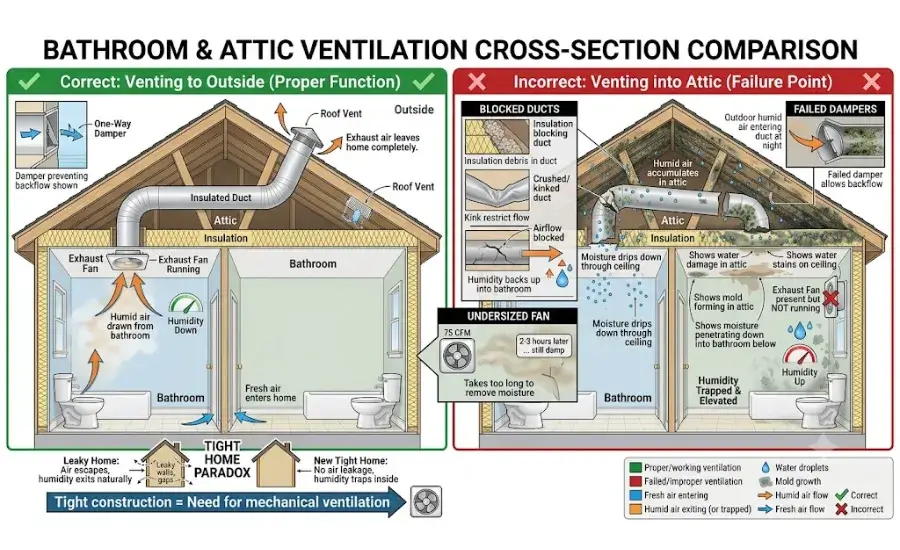
Properly functioning ventilation solves half the humidity problem. But ventilation often fails silently.
Exhaust fans not running waste opportunity. Fans installed but never activated provide zero benefit. Homeowners open windows instead, introducing humid Gulf air. This defeats the purpose. You’re adding humidity while trying to reduce it.
Exhaust ducts venting into attics instead of outside trap moisture dangerously. This pre-1995 construction mistake saturates attics. Moisture drips down through ceiling materials into living spaces below. Bathrooms develop ceiling mold. Bedrooms show water stains. Living rooms smell musty. The problem originates from improper attic venting.
Blocked exhaust ducts perform as poorly as absent ducts. Insulation blocks ducts during attic work. Crushed ducts restrict airflow. Deteriorated ducts leak air into cavities. When airflow stops, moisture backs up. Humidity accumulates instead of exiting.
Dampers that fail allow outdoor air backflow. Dampers prevent humid outdoor air from entering ducts when fans stop. Failed dampers hang open. Night air—humid and cool—enters ducts. Duct surfaces remain damp. Mold colonizes ducts. Morning fan operation spreads this mold throughout your home.
Undersized fans don’t move sufficient air. A fan rated for 75 CFM (cubic feet per minute) struggles in a large bathroom. Air can’t exchange quickly enough. Humidity lingers for hours after showers. Mold establishes in this extended humid period.
Home sealing for energy efficiency ironically worsens ventilation problems. Modern tight construction prevents air leakage. This improves heating and cooling efficiency but traps humidity inside. Without deliberate ventilation, humidity accumulates relentlessly. Tight homes need mechanical ventilation to stay healthy.
This is the ventilation paradox: modern efficiency requires modern ventilation. Older homes with poor sealing benefited from accidental air leakage. Newer tight homes must compensate with planned ventilation.
Sarasota homeowners often don’t realize their ventilation is failing. Humidity doesn’t announce its presence obviously. You don’t see humidity visually. Houses feel merely humid, not alarming. Meanwhile, hidden mold colonizes materials. By the time problems become obvious, extensive damage has progressed.
Preventing Mold by Managing Humidity in Sarasota
Understanding Sarasota’s humidity tells you where to invest prevention effort.
Run exhaust fans consistently. Bathroom fans should run during and for 30-60 minutes after showers. Kitchen fans need to operate during cooking and for 20 minutes afterward. Don’t shortcut this. Humidity lingers in air. Fans must run until humidity drops substantially.
Verify that exhaust fans vent outside your home, not into your attic. Climb into your attic. Follow the ductwork from your bathroom and kitchen. Trace where ducts terminate. External wall or roof venting is correct. Attic termination is a serious problem requiring immediate correction.
Maintain exhaust duct cleanliness. Quarterly inspections catch blockages before they become problematic. Clear any dust or debris. Verify airflow at termination points. Don’t assume ducts work—verify they do.
Use dehumidifiers in high-moisture areas. Basements and crawl spaces need continuous dehumidification. Set them to maintain humidity below 60 percent. Emptying buckets frequently means dehumidifiers are working—they’re removing moisture your home produces.
Maintain AC systems diligently. Clean condensation drain lines quarterly. Have professionals inspect systems annually. Replace air filters monthly. Well-maintained AC systems remove moisture efficiently. Neglected systems become mold factories.
Control kitchen and laundry moisture. Use range hoods. Vent dryers outside completely. Don’t skip these steps thinking air circulation handles everything. It doesn’t. Deliberate moisture removal works.
Open windows strategically during dry periods. Dry winter months (January-February) offer occasional low-humidity windows. Opening windows during these brief windows helps. But never open windows during humid summer months—you’re introducing moisture.
Grade soil away from foundations. Surface water drainage prevents groundwater from pooling near your home. Keep gutters clean. Direct downspout water away from foundations. These simple steps reduce foundation moisture infiltration.
Allow crawl space ventilation improvements. Vapor barriers slow moisture. Open crawl space vents during drier months (October-April). Closed crawl space vents trap moisture. Proper ventilation combines with moisture barriers.
Monitor humidity with digital meters. Inexpensive instruments show when humidity exceeds 70 percent. You know when to activate dehumidifiers or increase fan usage. Humidity measurement removes guesswork.
Accept that Sarasota humidity is permanent. You cannot eliminate it. You can only manage it aggressively. This mindset shift helps. Stop viewing humidity as abnormal. Treat it as Sarasota’s reality. Manage it as you manage summer heat or hurricane season.
FAQ: Pink Mold and Black Mold Myths Debunked
Embracing Sarasota’s Humid Reality
Sarasota’s climate creates mold conditions naturally. This isn’t your fault. You didn’t cause Sarasota’s 70 percent baseline humidity. You didn’t choose our shallow water table. You didn’t build our coastal location.
But you can manage these realities strategically. Understanding them transforms your prevention approach. Stop viewing mold as a sign of personal negligence. Start viewing it as Sarasota’s environmental challenge requiring persistent management.
Your climate differs fundamentally from Denver or Phoenix or Seattle. Their mold prevention strategies won’t work here because their humidity levels differ dramatically. Sarasota humidity demands aggressive Sarasota solutions.
This explains why your neighbor’s mold problems aren’t failure. This explains why mold detection doesn’t mean your home is uniquely problematic. This explains why vigilance requires constant effort rather than occasional attention.
Embrace this reality. Manage it actively. Invest in dehumidification. Maintain ventilation systems. Monitor humidity. Address water damage immediately. These actions work because they respect Sarasota’s climate rather than fighting it.
The humidity that makes Sarasota challenging also makes it beautiful. Lush landscaping thrives in this moisture. Coastal humidity creates stunning sunsets. Trade-offs exist. Understanding the climate trade-offs helps you make educated choices about your home’s defense.