AC Condensation and Mold: Why Your Air Conditioner May Be Making It Worse
Your AC unit runs constantly in Sarasota. It pulls moisture from the air every single day. That’s what keeps your home cool. But here’s what happens next: all that moisture has to go somewhere. Most of it drains outside through a condensation line. But when that line clogs or freezes, the moisture stays inside. Mold grows quickly in trapped moisture. Your air conditioner, meant to help, becomes the problem instead.
This guide explains what’s happening in your home right now. You’ll learn why Sarasota’s climate makes this worse. You’ll discover which AC parts grow mold fastest. Most importantly, you’ll find out what works to stop it.
How Air Conditioners Create Condensation
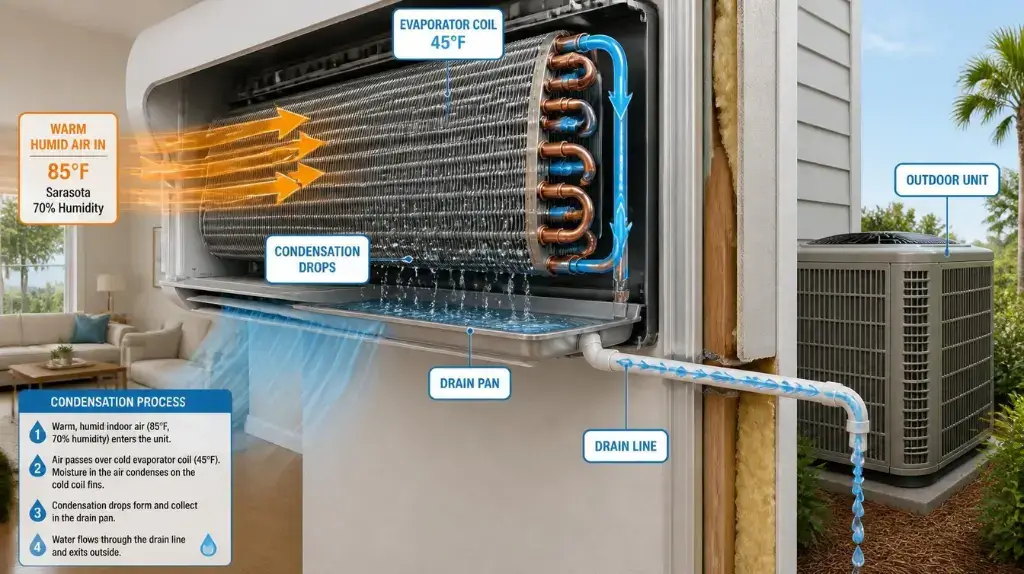
Your AC works by cooling air below its dew point. Cold air can’t hold as much moisture as warm air. So the moisture condenses into water droplets. This is the same process that creates dew on grass at sunrise.
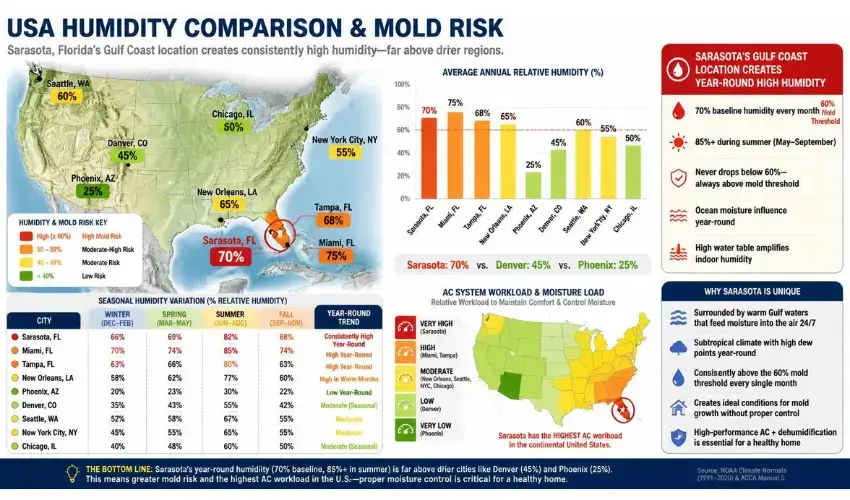
An AC unit removes roughly one to five gallons of water daily. In Sarasota, many systems remove even more. The humidity here sits at seventy percent year round. That’s thirty points above the safe indoor level. Your AC has to work constantly just to keep pace.
The evaporator coil is where condensation forms. This coil sits inside your indoor unit. Refrigerant circulates through it to cool the air passing over it. As warm, humid air hits this cold coil, moisture falls away. It drips down into a pan below the coil. From there, a drain line carries the water outside.
Is AC Condensation Normal?
Yes. Your AC should produce condensation. The question isn’t whether it drains, but how much and where it goes.
A properly working system drains water constantly outdoors. You might see water pooling under your outdoor unit on hot days. This is normal. A broken system leaves water sitting inside your home. This creates the perfect place for mold to grow.
Why Sarasota’s Climate Makes AC Condensation Worse
Sarasota sits on Florida’s Gulf Coast. The ocean brings moisture inland every single day. Our baseline humidity averages seventy percent. During summer months, it climbs above eighty five percent. This is among the highest in the nation.
Your AC condenses far more moisture here than in dry states. A system in Denver removes half what one in Sarasota removes. A system in Phoenix removes a quarter. Your air conditioner never gets a break in Sarasota. It runs nearly twelve months yearly. Every day it’s running, it’s producing condensation.
How Much Condensation Should Your AC Produce?
A working system in Sarasota produces one to five gallons daily. During summer peak months, some systems drain even more. You shouldn’t see puddles inside your home or in the attic. You shouldn’t smell musty odors coming from vents. You shouldn’t find wet insulation or discolored drywall. All these signs mean condensation isn’t draining properly.
When Does AC Condensation Lead to Mold Growth?
Mold needs two things to grow: moisture and warmth. AC units provide both. The condensation itself isn’t mold yet. Mold grows when condensation sits stagnant for twenty four hours or longer.
An AC system that drains properly never develops mold. An AC system with a clogged line creates standing water. Mold colonizes that water within two days. It spreads rapidly after that. Within a week, you have a real problem.
Can Condensation Turn Into Mold?
Condensation doesn’t become mold. Rather, mold grows in the condensation. These are two different processes. Condensation is just water. Mold is a living organism that feeds on that water. It also feeds on dust, dead skin cells, and fibers from your ductwork. All of these exist inside your AC system.
The condensation provides the moisture. The dark, damp AC system provides the temperature mold loves. Indoor AC systems stay around fifty five to sixty five degrees Fahrenheit. Mold thrives in this range. The combination is deadly for your home.
The Role of AC in Humidity Control
Your AC does more than cool your home. It removes moisture from the air. This lowers your indoor humidity level. A working system keeps indoor humidity between thirty and fifty five percent. This is the safe range according to ASHRAE, the American Society of Heating, Refrigerating and Air Conditioning Engineers.
When your AC fails to drain condensation, the opposite happens. Humidity rises instead of falls. Standing condensation turns into an indoor humidity problem. Mold spores float through the air looking for moisture. Your AC system just handed them exactly what they need.
Why Your AC Might Be Making Mold Worse
Here’s the real problem: your AC spreads mold throughout your home. When mold grows in the evaporator coil, spores break free. Your AC fan then pushes these spores through every duct in your home. They travel to your bedroom. They reach your living room. They enter your crawl space. Your AC becomes a delivery system for mold spores.
Every time you run your air conditioner, you breathe in more spores. Every time the system cycles on, it sends contamination through your ductwork. This continues until someone cleans the system or removes the mold source. A broken AC doesn’t just create mold. It distributes it everywhere.
Which AC Parts Are Most Prone to Mold?
Not every part of your AC system attracts mold equally. Some components create ideal conditions for growth. Understanding which parts are vulnerable helps you prevent problems before they start.
Evaporator Coil Mold: The #1 AC Problem
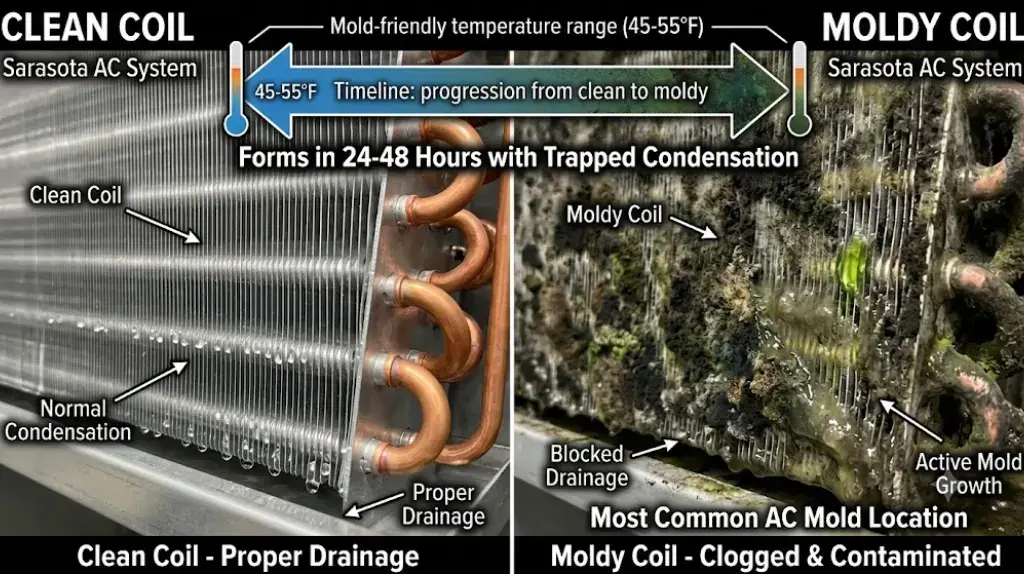
The evaporator coil sits inside your indoor unit. This is where ninety five percent of AC mold problems begin. Here’s why: the coil is cold, wet, and dark. Mold considers this paradise.
When the coil gets dirty, airflow slows. The condensation doesn’t dry fast enough. Mold spores land on the coil. They germinate within forty eight hours. Within one week, visible growth appears. This happens quickly in Sarasota’s humidity.
A professional needs to clean your evaporator coil yearly. This stops mold before it starts. Most homeowners never do this. They only call when they smell something foul. By then, the mold is thriving.
AC Drain Line and Mold Growth
Your condensation drain line carries water outside. It’s a small plastic tube, often just half an inch wide. Dirt clogs it constantly. Algae grows inside it. Dust gets sucked in from the air. Within six months, many drain lines slow to a trickle.
When the line clogs completely, water backs up into your system. It pools in the drain pan. Mold explodes in this environment. The stagnant water and darkness create perfect conditions. Mold grows here faster than anywhere else in your home.
Cleaning this line takes five minutes. Most homeowners never do it. This is where ninety percent of preventable AC mold problems start.
Condensation Pan: Why It’s a Mold Hotspot
The condensation pan sits below the evaporator coil. All the moisture from the coil drains into this pan. From there, it flows to the drain line outside.
A clean pan prevents mold. A dirty pan guarantees it. Dust collects in the pan. Dead skin cells accumulate. Bacteria grow. Once mold starts, it colonizes the pan completely. The slime grows thick and dark. It clogs the drain opening. Now water pools deeper in the pan. The problem worsens each day.
Many drain pans develop algae before mold appears. You’ll see green or black slime coating the bottom. This isn’t mold yet, but it’s close. Algae and mold feed on the same conditions. If algae is present, mold is coming.
HVAC Ductwork and Hidden Mold
Mold doesn’t stay in your AC unit. It spreads through your ductwork. Your ducts are dark, cool, and wet when things go wrong. Mold thrives here invisible to you.
Ductwork runs through attics and crawl spaces. These areas stay cool and damp year round in Sarasota. When mold spores enter the ducts, they settle on the duct walls. They feed on dust and fibers. They grow quietly until your home smells bad. By then, the infestation is serious.
Air Filter Mold and Air Quality
Your AC filter catches dust and debris. It also catches mold spores when they’re present. A filter full of mold spores stops working properly. Air can’t flow through it. Your AC struggles. Your energy bills rise. Your air quality plummets.
Mold on your filter means mold is flowing through your system. This indicates a deeper problem upstream. Your evaporator coil or drain line has mold. The filter is just the visible symptom.
Sarasota’s Unique AC and Mold Challenge
Sarasota isn’t like most of America. Our climate is tropical and humid every single month. This creates mold conditions most regions never experience. Your AC doesn’t just deal with seasonal humidity. It battles constant, relentless moisture.
Year Round AC Use Equals Continuous Condensation
Northern homeowners run their AC maybe six months yearly. They run heaters the other half. They don’t run both systems constantly. Sarasota is different. Many homes run AC year round. Winter temperatures still reach seventy five degrees most days. Homes stay at seventy two degrees. The AC runs nearly daily even in January.
Continuous operation means continuous condensation production. Your drain system gets no rest. It never dries out completely. This constant moisture creates ideal conditions for mold growth. A system that produces condensation three hundred sixty five days yearly faces greater mold risk than one running seasonally.
Sarasota’s High Water Table Problem
Sarasota sits on an ancient limestone base. The water table sits ten feet below ground surface. In many areas, it’s much shallower. This means moisture wicks upward through your foundation. This affects your crawl spaces and basements most. But it also influences your whole home’s humidity level.
Homes built on high water tables experience higher indoor humidity. Your AC has to remove more moisture. It produces more condensation. Your drain system works harder. Your mold risk increases. This is a Sarasota specific problem that homeowners on Longboat Key and Siesta Key understand well.
Gulf Coast Salt Air and AC Systems
Salt air corrodes AC components. Your condenser unit sits outside exposed to salt spray. The metal components rust faster here than inland. Refrigerant lines corrode. Fittings weaken. Metal drain pans develop holes. Once a drain pan develops a hole, water leaks inside your attic or crawl space.
Salt air also affects indoor components. Dust inside your home contains salt particles. These settle on your evaporator coil. They trap moisture and encourage mold growth. Systems in Tampa or Orlando don’t face this issue. Sarasota’s coastal location creates additional challenges.
Hurricane Season and AC Mold Risk
Hurricane season runs June through November. Homes here face major moisture threats. Flooding brings saltwater into crawl spaces and basements. Standing water takes weeks to dry completely. Your AC can’t lower humidity when water sits stagnant below your home.
After hurricanes, mold grows explosively. Professional remediation companies report their busiest season follows storms. If your AC system was already struggling, a hurricane makes it catastrophic. Your AC can’t handle the additional moisture burden. Your home develops mold throughout crawl spaces, attics, and ducts.
Homeowners in Palmer Ranch and Lakewood Ranch saw this after Hurricane Ian. Water in crawl spaces stayed for months. AC systems ran continuously trying to manage humidity. Many developed serious mold problems. Some homeowners had to replace entire systems.
Signs Your Air Conditioner Is Causing Mold
Mold in your AC doesn’t always announce itself loudly. Some signs are obvious. Others are subtle. Catching mold early stops expensive remediation later. Here’s what to watch for in your Sarasota home.
Musty Smell Coming From AC Vents
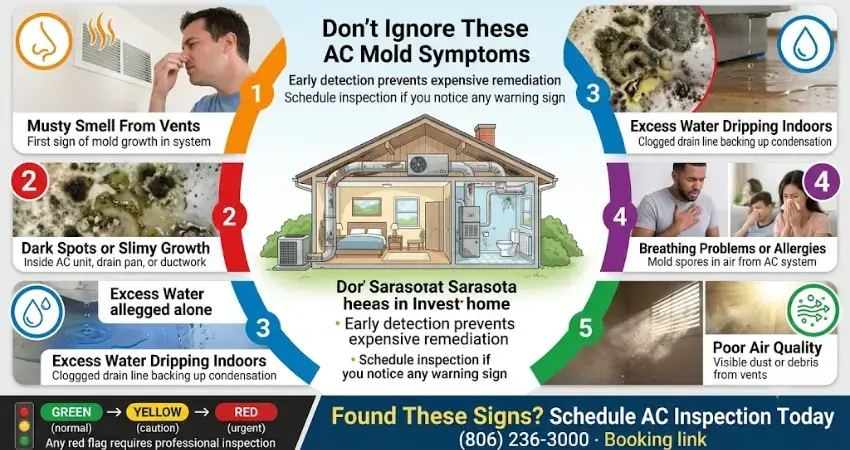
A musty smell from your vents is your first warning. This smell comes from mold growing in your system. Mold produces volatile organic compounds. Your nose detects these even in tiny amounts. The smell gets stronger near air return vents. It’s strongest when your AC first turns on.
If you smell this in your master bedroom on Gulf Gate Drive or your living room on Siesta Key, don’t ignore it. This smell means mold is already established. Your system needs cleaning immediately. The longer you wait, the more mold grows.
Visible Mold in AC Units or Ductwork
Sometimes you can see mold directly. Look at your indoor AC unit. Check the evaporator coil if you can access it. Black, green, or white fuzzy growth is mold. Slimy growth inside the drain pan is mold. Dark staining on ductwork is mold.
You might see this in your attic if your AC unit sits there. Some homes have attic units in Sarasota. You might see it in a crawl space if your indoor unit is mounted there. Any visible growth means the problem is serious. Professional cleaning is necessary.
Excess Water Dripping From AC
Water pooling under your outdoor unit is normal. Water dripping inside your home is not. If you find wet spots in your attic near your AC unit, something is wrong. If water pools in your crawl space near the indoor unit, your drain line has failed.
Water leaking inside means condensation isn’t draining outside. This water sits in your system or ducts. Mold colonizes this water quickly. You need a professional to find and fix the leak.
Poor Air Quality or Breathing Issues
Mold spores in your air cause health problems. Breathing becomes harder. Allergy symptoms worsen. Some people develop respiratory infections. Children and elderly residents are most vulnerable. People with asthma experience more frequent attacks.
If your family’s health issues improve when you leave your home, your indoor air is the problem. Your AC might be the source. Mold spores from your system are contaminating everything you breathe.
Dark Spots on AC Components
Look inside your indoor AC unit. Look at the drain pan. Look at visible ductwork in your attic or crawl space. Dark spots or staining indicate mold. This can appear black, green, or brown. It might look slimy or powdery.
Don’t touch it. Mold spores spread when disturbed. Professional remediation uses proper containment and protective equipment. Trying to clean mold yourself spreads the problem.
How to Prevent Mold in Your AC System
Prevention stops mold before it starts. These strategies keep your AC clean and your home safe. Most are simple. Some require professional help. All of them cost far less than mold remediation.
Regular AC Filter Replacement
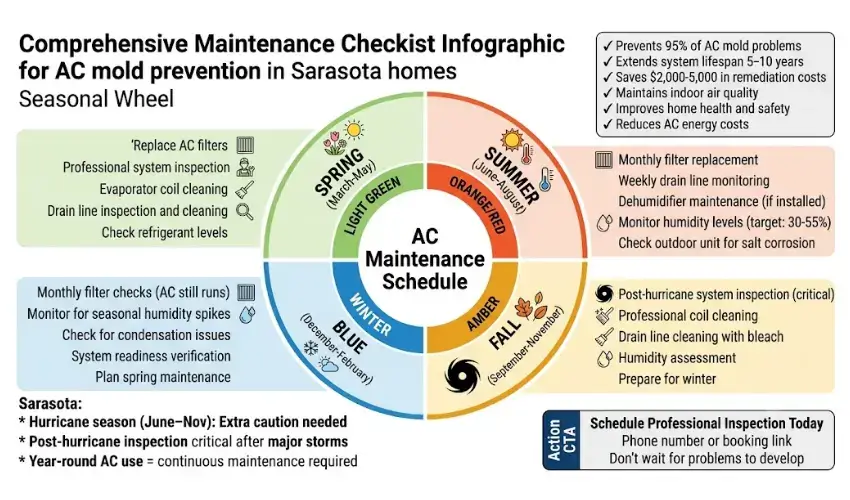
Your AC filter is your first line of defense. It catches dust and spores before they reach your coil. A clogged filter reduces airflow. Reduced airflow means the coil stays wet longer. Wet coils grow mold. Replace your filter monthly during peak cooling season. Replace it every three months during lighter use. A clean filter solves half your mold prevention problem.
AC Drain Line Cleaning and Maintenance
Your drain line needs cleaning twice yearly. Do this in spring before peak cooling season. Do it again in fall before winter humidity sets in. A simple process prevents ninety percent of drain line problems.
Pour one cup of bleach down your drain line opening. Let it sit for thirty minutes. Flush it with water. This kills algae and mold before they clog the line. If water backs up and won’t drain, you need a professional. A clogged line that won’t clear needs professional cleaning with a drain auger or wet vac.
Evaporator Coil Cleaning Schedule
Professional coil cleaning should happen yearly. This costs around one hundred to three hundred dollars. Neglecting this costs thousands later when remediation becomes necessary. A professional uses special coil cleaner and tools. They don’t damage the delicate fins. They dispose of contaminated water properly. They contain any mold spores to prevent spread.
Maintain Indoor Humidity Levels
Keep your indoor humidity between thirty and fifty five percent. Most modern AC systems with working drain lines maintain this automatically. You can verify using an inexpensive humidity meter. If humidity stays above sixty percent despite a running AC, your system has a drainage problem.
You can lower humidity using a dehumidifier in problem areas. Place one in your crawl space. Place one in your basement. These help but don’t fix the underlying AC issue. Fixing the AC remains most important.
Ensure Proper AC Ductwork Insulation
Poorly insulated ducts sweat in Sarasota’s humidity. Condensation forms on the outside of ducts. Mold grows on this condensation. The ducts themselves then become mold sources. Ductwork should be insulated with at least R-8 insulation. R-11 or higher is better in high humidity areas.
If your ducts aren’t properly insulated, have them wrapped or enclosed. This prevents external condensation. It’s an investment that prevents mold problems.
Regular HVAC Professional Maintenance
Schedule professional maintenance twice yearly. Do it in spring and fall. A technician inspects your entire system. They check for refrigerant leaks. They verify airflow. They clean your drain pan. They test your thermostat. They check for corrosion on outdoor components.
A thorough inspection catches problems before they become serious. Small issues get fixed before turning into mold infestations.
Fix AC Leaks Immediately
Refrigerant leaks reduce cooling capacity. Your system runs longer. It removes less moisture. Condensation builds up. Water sits in your drain pan. Your mold risk skyrockets.
Water leaks from your indoor unit or ducts mean drain problems. Both need immediate attention. Don’t delay. Each day of delay gives mold more time to grow.
Install Condensation Drain Pan Float Switch
Many newer systems include a float switch in the drain pan. This device detects standing water. When water level gets too high, it shuts off your AC. This prevents water from overflowing. Some switches trigger an alert on your thermostat. This tells you a problem exists.
If your system lacks this safety feature, consider adding one. Installation costs one hundred to two hundred dollars. It’s cheap insurance against expensive mold problems.
Can You Fix AC Mold Yourself or Do You Need a Professional?
Some AC problems homeowners can address. Mold isn’t one of them. Understanding the difference between preventive maintenance and mold remediation matters. Prevention you can do. Remediation you cannot.
DIY AC Mold Cleaning Methods
You can perform prevention maintenance. You can replace filters. You can clean drain lines with bleach. You can install dehumidifiers. These don’t touch existing mold. They prevent future mold. If mold already exists, these won’t fix it.
Some online sources suggest using household cleaners on visible mold. This fails for several reasons. Mold inside your AC unit isn’t easily reached. You can’t clean behind the coil without special tools. You can’t prevent spore spread without proper equipment. You can’t verify that you killed all mold. You likely make the problem worse.
When Professional HVAC Cleaning Is Necessary
You need a professional as soon as you suspect mold. Signs include musty smells, visible growth, water leaks, or air quality problems. Professionals have tools homeowners lack. They have negative pressure equipment. They contain mold spores during cleaning. They use biocides rated for HVAC systems. They know which products won’t damage your equipment.
A professional inspection identifies the mold source. They find the drainage failure causing it. They clean the affected areas. They address the underlying cause. This prevents the problem from recurring. If you’re in the Sarasota area, a licensed HVAC mold removal service can handle coil cleaning, drain line clearing, and duct treatment in a single visit.
Cost of DIY vs. Professional AC Mold Removal
Drain line cleaning costs nothing to thirty dollars if you do it. A professional charges fifty to one hundred fifty dollars. Filter replacement costs fifteen to thirty dollars regardless. Dehumidifier installation costs twenty dollars if you do it.
Evaporator coil cleaning costs one hundred to three hundred dollars professionally. Trying this yourself risks damaging your system. The repair bill for a damaged coil exceeds two thousand dollars.
Full HVAC mold remediation costs five hundred to three thousand dollars. This depends on how much of your system is affected. Crawl space or attic remediation adds to this cost. Caught early, remediation stays under one thousand dollars. Ignored, it reaches five thousand or more.
Risks of Ignoring AC Mold Problems
Mold spreads quickly in AC systems. What starts in your evaporator coil reaches your entire ductwork within weeks. What affects your attic air handler spreads to crawl space ducts. Mold that’s limited to your system today spreads to your home tomorrow.
Your health suffers. Respiratory issues worsen. Allergies become more severe. Some people develop fungal infections. Kids miss school. Adults miss work. Quality of life drops.
Ignoring mold makes everything worse. The problem doesn’t fix itself. It compounds each day. Eventually, you need professional mold remediation for your entire home, not just your AC system. This costs far more than early AC cleaning.
What Experts Say About AC Condensation and Mold
Guidelines from major organizations shape best practices for AC mold prevention. These aren’t just suggestions. They’re standards developed through decades of research and real world experience.
ASHRAE Humidity Control Standards
ASHRAE publishes standards for heating and cooling systems. Their guideline is clear: indoor humidity should stay between thirty and fifty five percent. This range prevents mold growth. It also prevents dust mites. It keeps people comfortable.
Your AC should maintain this range automatically. If your home stays above sixty percent humidity despite a running AC, your system isn’t working correctly. ASHRAE recommends professional evaluation in this situation.
EPA’s Indoor Air Quality Guidelines
The Environmental Protection Agency addresses mold in homes. Their guidance emphasizes prevention over remediation. They recommend controlling moisture first. An AC system that drains properly is your first line of defense. They recommend fixing leaks and maintaining systems.
They note that mold can grow on any surface with moisture and dust. AC systems provide both. EPA recommends professional cleaning if mold is suspected. They note that mold can grow on any surface with moisture and dust. AC systems provide both. EPA recommends professional cleaning if mold is suspected. You can review the EPA’s guidance on mold prevention and moisture control for more detail on their recommended approach
Professional HVAC Maintenance Recommendations
HVAC contractors recommend twice yearly service. Spring service prepares your system for summer cooling season. Fall service prepares it for any winter humidity spikes. These visits catch problems early. They prevent emergency situations.
Most contractors recommend annual coil cleaning in high humidity areas. Sarasota definitely qualifies. Yearly cleaning prevents mold from establishing. It’s far cheaper than remediation.
AC Mold Solutions for Sarasota Homeowners
General solutions work elsewhere. Sarasota needs specific answers. Our climate, humidity, and coastal conditions create unique challenges. Here’s what actually works here.
Dehumidifiers for Sarasota Homes
Dehumidifiers work best in specific spaces. They don’t solve AC drainage problems, but they help. Place one in your crawl space to lower ambient humidity. This reduces moisture wicking into your home. Place one in your attic if you have an attic unit there. This keeps the component area dry.
Don’t rely on dehumidifiers as your primary solution. They’re supplements to proper AC maintenance. They lower humidity but use significant electricity. In Sarasota where electricity costs are high, they’re expensive long term. Fix your AC first. Use dehumidifiers as a secondary strategy.
Professional HVAC Inspection Process
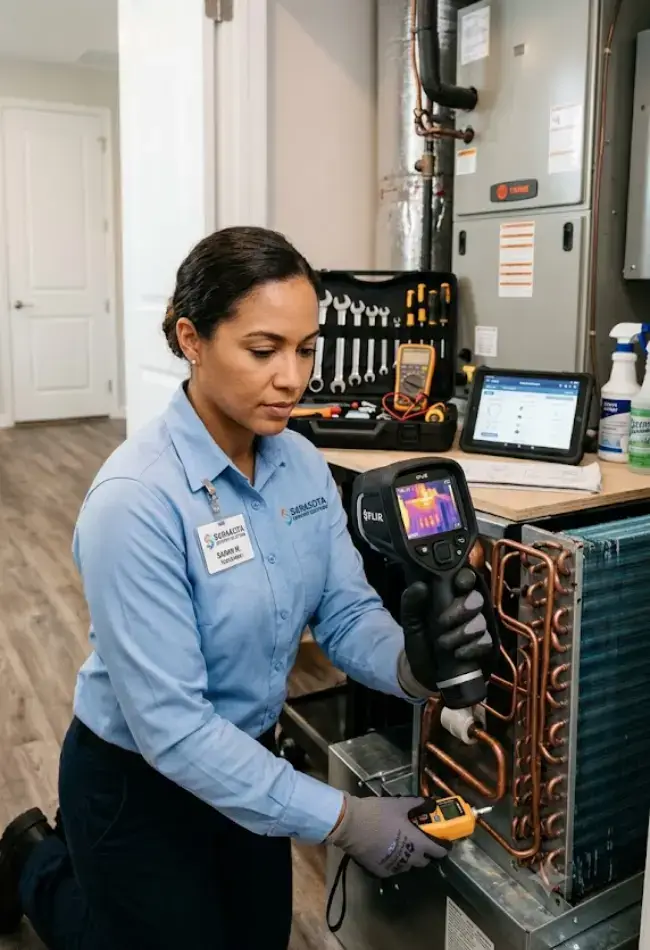
A proper inspection takes ninety minutes to two hours. It includes testing refrigerant charge. It includes checking airflow. It includes inspecting every component. It includes testing your drain system. It includes checking for leaks. It includes verifying thermostat operation.
The inspector should provide a written report. This details findings and recommendations. It specifies what needs immediate attention. It specifies what can wait. Some issues are critical. Some are minor. A good report helps you prioritize spending.
Humidity Resistant AC Systems
Newer AC systems handle humidity better than older ones. Larger capacity systems remove more moisture. Properly sized systems run efficiently. Undersized systems run continuously. Oversized systems cycle too often. Both create problems. Right sizing matters.
If your system is over twenty years old, replacement might be cheaper than continuous repairs. Newer systems cost less to operate. They handle humidity better. They last longer. The investment pays back through lower energy bills.
Post Hurricane AC System Checks
After major storms, inspect your AC system immediately. Check for water in your crawl space or attic. Check for refrigerant leaks. Check your drain pan and lines. Have a professional check for saltwater intrusion on outdoor components.
If water entered your home, your AC system needs a professional inspection. Standing water around your outdoor unit needs attention. Don’t wait for problems to develop. Storms create conditions mold loves. Act fast to prevent it.
AC Condensation and Mold: Frequently Asked Questions
People ask the same questions repeatedly. These answers address the most common concerns Sarasota homeowners have.
Is AC Condensation Normal?
Yes. AC systems produce condensation. This water must drain outside. If it drains properly, you never see it. If your drain line fails, water backs up inside your system. Then mold can grow. The condensation itself is normal. Standing condensation isn’t.
Can Air Conditioning Cause Mold?
Air conditioning itself doesn’t cause mold. A failed AC drainage system causes mold. An AC unit that removes humidity prevents mold. An AC unit with a clogged drain creates mold. The system itself is innocent. The maintenance failure is guilty.
Does Mold in AC Make You Sick?
Yes. Mold spores in your air cause health effects. Respiratory irritation is most common. Allergic reactions happen frequently. Some people develop infections. People with asthma experience worse symptoms. Children and elderly people are most vulnerable.
How Often Should I Clean My AC?
Replace your filter monthly during cooling season. Clean your drain line twice yearly. Have your evaporator coil professionally cleaned yearly. Have your entire system serviced twice yearly. This schedule prevents mold in Sarasota’s climate.
What’s the Cost of Professional AC Mold Removal?
Costs vary based on how much mold is present. Limited mold in just the evaporator coil costs five hundred to one thousand dollars. Mold throughout your ductwork costs one thousand to three thousand dollars. Full home remediation with crawl space or attic treatment costs three thousand to five thousand dollars.
How Long Does Mold Stay in AC Ducts?
Mold persists indefinitely once established. It won’t disappear on its own. It won’t die during winter hibernation. It survives any season. It continues growing until you remove it. The longer you wait, the more extensive it becomes.
Can I Prevent AC Mold Without Professional Help?
You can prevent mold through maintenance. Replacing filters, cleaning drain lines, lowering humidity with dehumidifiers, and getting yearly professional coil cleaning prevents mold formation. These are preventive measures. Once mold exists, you need professional remediation.
Should I Replace My AC System if It Has Mold?
Not always. Localized mold in your evaporator coil can be cleaned. System replacement isn’t necessary if caught early. Extensive mold throughout your ductwork might make replacement cheaper than full remediation. A professional can assess your situation and advise whether cleaning or replacement is better.
Don’t Let AC Mold Damage Your Home
Mold doesn’t wait for convenient timing. It grows whenever conditions allow. Your air conditioner should prevent mold. When it fails, mold thrives. The good news is that prevention works. Simple maintenance stops most mold before it starts.
Schedule Your AC Mold Inspection Today
Call a licensed HVAC contractor in Sarasota. Request a full system inspection. Ask them to check your evaporator coil, drain line, and condensation pan. Ask them to verify your system drains properly. Get their assessment in writing. Don’t delay if they find problems.
Early detection and treatment prevents expensive remediation. One inspection appointment now avoids emergency situations later.
Why Sarasota Homeowners Trust Professional Solutions
Sarasota’s humidity creates unique challenges. Local contractors understand these challenges. They know which systems perform best here. They understand our water table issues. They’ve handled mold problems repeatedly. They know what works and what doesn’t.
Nationwide solutions don’t account for our coastal climate. Our high water table. Our hurricane season. Our year round heat. Our year round AC use. Local expertise matters.
Get a Free AC System Assessment
Most HVAC companies offer free inspections. This takes about an hour. They assess your system’s condition. They identify any problems. They provide a written report. You get actionable information at no cost. You can then decide your best course of action.
Schedule this inspection in spring before summer cooling season. Problems caught now get fixed before they worsen. You’ll have peace of mind knowing your system is clean. You’ll breathe easier knowing your AC is working properly. Your home will stay healthy through Sarasota’s humid season.